Showing posts with label energy efficiency improvements. Show all posts

Monday, January 23, 2012

Hagerstown's streetlight project

We visited Hagerstown last summer and wanted to share their successful project with you.  Maybe the bright, sunny photos we snapped back then will brighten your winter day!

Hagerstown used its $61,111 Energy Efficiency & Conservation Block Grant (EECBG) to replace 62 streetlights along State Road 38, which is a main corridor through the town. The previous streetlights were replaced with 62, 129 Watt LED Roadway Luminaries.

As a result, they’ve seen some good energy savings. They’ve saved 9,739 kWh and $838.38 in energy costs so far.  Not only are the streetlights adding the ambiance of this pretty town, it is also keeping its pedestrians and drivers safe while being energy efficient!

In a nutshell: It is rewarding when you can both literally and figuratively brighten a community’s day! Or in this case, I guess it is literally brightening their night.
Hagerstown received an Energy Efficiency & Conservation Block Grant (EECBG) award from the Indiana Office of Energy Development in 2010.  The EECBG program is funded through the American Recovery & Reinvestment Act of 2009 and the U.S. Department of Energy.

Thursday, January 19, 2012

Custom Coating's EECBG project


Custom Coating in Auburn (all the way up in Dekalb County) had no previous experience with grants, but decided that our Energy Efficiency & Conservation Block Grant (EECBG) would certainly be worth their time. And was it ever! This company had a total project cost of $26,741.16 and received $13,807.58 in EECBG funds for their lighting project.

Four different buildings were retrofitted for more energy efficient lighting. Fifty-three (53) H.I.D. fixtures were retrofitted with forty-five (45) T5 fixtures and eighty-four (84) T12 fixtures were retrofitted with forty-seven (47) T5 fixtures.

The best news is that within months, their eletric consumption was reduced by more than 30,000 kWh, obviously saving the company money as well.
 

Tuesday, January 17, 2012

Double whammy for New Castle’s EECBG award

The City of New Castle was a recipient of $196,810 in EECBG funding back in 2010.   The City used the funding to replace an inefficient boiler and chiller with more efficient equipment and to retrofit and replace lighting fixtures in several city-owned buildings.

New Castle is no stranger to receiving grants, either. They’ve received several other grants to improve the city and late last year, we announced them as a participating community in our Community Energy Plan program.
Keep up the good work, New Castle!

Wednesday, January 11, 2012

Farmersburg and EECBG

Like many small communities in Indiana, Farmersburg is always looking for ways to save on energy costs and better serve the community. With over $90,000 in grant money, Farmersburg was able to help take steps towards their energy savings goals by improving the Town Hall and municipal buildings that include the Town Garage and wastewater treatment facility.

Using EECBG funds, the Town Hall/Garage facility was retrofitted with 3 new exterior entry doors, double-pane windows, insulation, and new higher efficiency, Energy-Star rated HVAC equipment. In addition to the benefit offered by more energy efficient products, the insulation and replacement windows and doors serve to reduce the amount of air leakage from the existing units. These improvements also make the building a more comfortable place to work. The municipal sewage treatment facility (WWTP) was retrofitted with improved insulation, new windows, and higher efficiency, Energy Star rated HVAC equipment.


These improvements are estimated to represent a combined $14,650 in annual savings in energy expenditures for the town. Both pre- and post-improvement energy audits were performed for the project. WIN Energy, the local power provider, offers these audits to as a service to its customers. These audits have allowed Farmersburg to more fully quantify the improvements achieved through the project activities.
The Town of Farmersburg received an Energy Efficiency & Conservation Block Grant (EECBG), a program funded through the American Recovery & Reinvestment Act (ARRA) of 2009.  EECBG is a program of the U.S. Department of Energy, administered through the Indiana Office of Energy Development.

Monday, January 9, 2012

Arcadia & Hamilton Heights School Corp. partner for energy efficiency


The Town of Arcadia, in partnership with the Hamilton Heights School Corporation (HHSC), has set forth a plan for all four school buildings to become Energy Star rated. And have they been busy!
With the help of a $350,000 EECBG award from our office, the school corporation completed phase 2 of their energy project.  This consisted of the following:  update lighting to current energy efficient technology, upgrade the HVAC, replace windows, install occupancy sensors, upgrade boiler controls, and install a dedicated heat recovery chiller with pumps and controls, among other projects.

The school anticipates a savings of $73,408/year, 973,044 kWh, 3544 dekatherms of gas, and 941 CO2 emissions equivalents.

The Town of Arcadia received an Energy Efficiency & Conservation Block Grant (EECBG) award from the Indiana Office of Energy Development.  EECBG is a program of the U.S. Department of Energy, funded through the American Recovery & Reinvestment Act (ARRA) of 2009.

Thursday, January 5, 2012

Showing off Greencastle's new lights

Lighting projects always have unintended benefits. The City of Greencastle has learned this through the installation of new LED Traffic Signals and improved lighting at the Fire Department. New traffic signals have not only reduced energy consumption, but require far less maintenance. Traffic will not need to be interrupted as often to make repairs and replace worn out lights. Greencastle was also able to install pedestrian signals with a countdown feature. It's something that those of us in Indianapolis may take for granted as a normal feature of most signals, but is a newer feature to Greencastle that will hopefully add to the safety of the community.

The second part of the project was lighting upgrades at the Fire Department. Existing T12 fluorescent light fixtures were retrofitted with new T5 fluorescent light fixtures and new energy saving electronic ballasts that allow firefighters to see better throughout the building. Highbay Metal Halide light fixtures in the garage bays were replaced with new LED light fixtures providing increased light. And in the interior new lighting and occupancy sensors will aid in the energy savings.

It is estimated that these projects will pay for themselves in less than a year.

The City of Greencastle received an Energy Efficiency & Conservation Block Grant (EECBG), funded through the American Recovery & Reinvestment Act (ARRA) of 2009.  EECBG is a program of the U.S. Department of Energy and is administered by the Indiana Office of Energy Development.

Tuesday, January 3, 2012

Back to Health Wellness installs geothermal


Dr. Kirkham at Back to Health Wellness in LaPorte knew he needed to upgrade his old inefficient HVAC system. After consulting a local contractor to get a quote, they asked if had ever considered a geothermal system. They had not, but after a little research and an evaluation of his building he decided this was the system for him.

Geothermal heating and cooling uses the relatively constant temperature of the earth to heat and cool homes and businesses with 40% to 70% less energy than conventional systems. While conventional furnaces and boilers burn a fuel to generate heat, geothermal heat pumps use electricity to simply move heat from the earth into buildings, allowing much higher efficiencies. The most efficient fuel-burning heater can reach efficiencies around 95%, but a geothermal heat pump can move up to 4 units of heat for every unit of electricity needed to power the system, resulting in a practical equivalence of over 400% efficiency.

With a total cost of $57,000, the system was more expensive, but the savings and low maintenance made the geothermal system worth the extra cost. In total three inefficient 30 year old furnaces and air conditioners (one did not even work) were replaced with geothermal heating cooling system. In addition to this, inefficient water heaters were replaced with tankless water heaters. It is estimated that Back to Health Wellness has saved almost $9,000 and the geothermal system will pay for itself in around 6 years.

Back to Health Wellness Center received an Energy Efficiency & Conservation Block Grant (EECBG), funded through the American Recovery & Reinvestment Act (ARRA) of 2009.  EECBG is a program of the U.S. Department of Energy and is administered by the Indiana Office of Energy Development.

Tuesday, December 20, 2011

An educational energy efficiency trip to Franklin College

This past summer, the grueling heat once again reminded us all of how much we value our air conditioning (remember those days, when it wasn't freezing cold outside?).  At Franklin College, the Hamilton Library has become a great escape for students from the hot and sticky conditions outdoors (and to study too, of course!).  This is in large part attributed to the school’s decision to use an EECBG grant from our office to replace the original cooling tower for the library with a brand new one.  School officials have noted a substantial increase in the number of library patrons since the project was completed in August of 2010. 
As the main academic library for the school, Hamilton Library is home to many rare documents and materials, and thus to more than a fair share of research papers as well.  With such important work to be done, Franklin College recognized the importance of providing a comfortable, constructive work environment for students.  And in addition to aiding with typical assignments and research, the project was also the subject of articles written by students from various majors.  These students were able to learn more about energy efficient technologies and gain insight into the world of green energy.  One thing they certainly learned was that great savings can accompany energy efficiency!  As of April 2011 the school had already saved 318,203 kWh.

We are grateful to all of the students and staff at Franklin College for being so excited about this great project and for allowing us to visit!

Franklin College is a recipient of an Energy Efficiency & Conservation Block Grant (EECBG), a program of the American Recovery & Reinvestment Act (ARRA) of 2009.  EECBG is funded through the U.S. Department of Energy and is administered by the Indiana Office of Energy Development.

Monday, December 19, 2011

Catching up with the Salvation Army

 
The Salvation Army in New Albany is a great community organization that helps so many people in Southern Indiana. Energy savings from their EECBG project will allow them to continue on with their mission and hopefully touch additional people’s lives.

Their building had seen better days and was extremely inefficient. With their EECBG grant of $100,000 (of which they matched with $100,000), the Salvation Army was able to install new insulation for their roof, install a new heating system with three new heaters, retrofit 46 lights, and install 26 skylights. The purpose of this project was to substantially reduce energy consumption, lower maintenance and capital costs and lower the environmental impact of the facility.

Their goals have been met -- so far, they've saved 131,200 kWh and 1,0655 MMBTUs.

Great job, and thank you for your efforts to improve your community!

The Salvation Army of New Albany received an Energy Efficiency & Conservation Block Grant (EECBG), a program of the American Recovery and Reinvestment Act (ARRA) of 2009.  EECBG is funded through the U.S. Department of Energy and is administered by the Indiana Office of Energy Development.

Friday, December 16, 2011

A visit to Coal Creek Fire and Rescue

We are always grateful to our men and women who are willing to serve their communities, be it through the military, the police force, firefighter task forces, etc.  Coal Creek Fire & Rescue is filled with these noble men and women who work each and every day to provide safety and security to the public. 

Located in New Richmond, Indiana, Coal Creek Fire & Rescue is not your typical fire station.  As a volunteer fire station, each of its individual firefighters give their time and resources to provide emergency services to their community.  So when the station applied for one of our grants, we were excited to be a part of such a worthy cause.
 The interior of the fire station is divided into three main areas, two of which house the office, bathrooms, utilities, and the kitchen/training room.  These two areas both received new high efficiency furnaces and condenser units, as well as some modifications to the existing ductwork.  The third area, the truck bay, had insulation put in to trim down the amount of air infiltration around overhead doors and beams.
 
We would like to thank Coal Creek Fire & Rescue for all of their sacrifice and hard work, as well as for allowing us to visit. We certainly hope that the new modifications will provide you with some much deserved comfort and relaxation.
 
Coal Creek Fire & Rescue received an Energy Efficiency & Conservation Block Grant (EECBG), a program of the American Recovery & Reinvestment Act (ARRA) of 2009.  EECBG is funded through the U.S. Department of Energy and is administered by the Indiana Office of Energy Development.

Thursday, December 15, 2011

Road trip to Deaconess Hospital in Evansville

Some of our favorite feedback to hear from our grant recipients is that their projects are yielding significant savings, and in the case of Deaconess Hospital, Inc. in Evansville, we sure do have a lot to be excited about! Completing its project in December of 2010, Deaconess Hospital, Inc. reported savings of 599,526 kWh and $50,960 in electricity costs as of April of 2011, as well as 8,744 MMBTU and $20,645 in natural gas costs! 

So how did Deaconess use their grant money in order to accomplish such huge savings?  The actual project included replacing 48 temperature sensors and control panels in the hospital with more efficient models. But would you believe that the $100,000 grant is just one aspect of the hospital’s larger efficiency initiatives planned for the future?!  In fact, the funding was categorized as a part of “Phase 1” of the hospital’s efficiency efforts.  With such amazing savings already, we are excited for this money to be able to be redirected towards the hospital’s other important needs and for the hospital to experience further savings in the future.

Thank you to Deaconess Hospital for allowing us to visit.  You are a great example of what incredible feats in energy efficiency we can accomplish together!

Deaconess Hospital received an Energy Efficiency & Conservation Block Grant (EECBG), a program of the American Recovery and Reinvestment Act (ARRA) of 2009.  EECBG is funded through the U.S. Department of Energy and is administered by the Indiana Office of Energy Development.

Wednesday, December 14, 2011

Showing off Sullivan County Community Hospital's EECBG project

Of all of the places in need of ensuring that temperatures are appropriate and conditions are comfortable, a hospital is certainly at the top of the list.  Certain environmental conditions are often essential to keeping patients stabilized and in good health.  Thus, when the Sullivan County Hospital applied for one of our grants, we were happy to help.  


The Sullivan County Hospital used grant funds to take several measures that would create a more secure and relaxing environment for patients and staff.  First, the hospital installed a Pulse Condensing Boiler that reaches up to 97.5% efficiency. Secondly, they put in a Heat-Timer Mini-Mod-CN control system as an accompaniment to the boiler. And finally, the hospital finished it all off with natural gas and hydronic piping installation.  Estimated energy savings to date (the project was completed in December of 2010) was a  total 40,790 MMBTU. Those are some great savings!

Sullivan County Community Hospital received an Energy Efficiency & Conservation Block Grant (EECBG), a program of the American Recovery and Reinvestment Act (ARRA) of 2009.  EECBG is funded through the U.S. Department of Energy and is administered by the Indiana Office of Energy Development.

Tuesday, December 13, 2011

Ball Memorial Hospital

Last year, Ball Memorial Hospital completed an energy efficiency project through the help of an EECBG award from our office.  These new energy efficiency improvements include the installation of automated air-handler drives and controls, the installation of lighting sensors, and upgrades to the steam pipe and its insulation.  In total, Ball Memorial Hospital estimates to save over $78,000 per year, giving the project a payback of less than 3 years.

In addition to these types of upgrades the Hospital has implemented a Go Green initiative throughout its facilities with strong support of administration and participation by its employees.  The hospital has one of the largest green roofs in Indiana located on a new energy efficient patient tower.   As part of the Go Green initiative, a Green Team has been formed which is composed of a recycling, waste reduction, energy conservation, education and research committees. 

The hospital's goal is to become and remain a sustainable health care facility.  To do so, the hospital must educate the community and its employees regarding the availability of recycling management programs, waste reduction programs, and with the assistance of its employees, must implement energy savings and conservation practices throughout the Hospital campus facilities.

We thank Ball Memorial Hospital for their good work on the EECBG project.  We look forward to hearing more about your future green initiatives!

Ball Memorial Hospital received an Energy Efficiency & Conservation Block Grant (EECBG) through the American Recovery & Reinvestment Act (ARRA) of 2009.  EECBG is funded through the U.S. Department of Energy and is administered by the Indiana Office of Energy Development.

Monday, December 12, 2011

City of Monticello and EECBG

Known for its 2 large lakes, festivals, and outdoor activities, the City of Monticello is a great place to spend the day.  As with any small community in Indiana they are always looking for ways to improve, and to save money.
With $57,500 in grant money from the Indiana Office of Energy, the City of Monticello was able to upgrade the lighting systems at the following Town-owned buildings: City Municipal Building, City Water Works, City Waste Water Treatment Plant, and the Council on Aging Building.  These improvements included 191 new T8 lights, 8 new LED exit signs, 43 new outdoor induction wall mount lights, and 22 new T5 lights. 
Monticello was interested in upgrading the lighting fixtures of the buildings they own in order to decrease their operating expenses and increase the overall lighting quality within the buildings.  The lighting fixtures were generally outdated and required frequent maintenance. Lighting upgrades have reduced their monthly utility bills and maintenance costs.  The projected utility savings is $11,000 per year. 


The City of Monticello received an Energy Efficiency & Conservation Block Grant (EECBG), funded by the American Recovery & Reinvestment Act (ARRA) of 2009.  EECBG is funded through the U.S. Department of Energy and is administered by the Indiana Office of Energy Development.

Friday, December 9, 2011

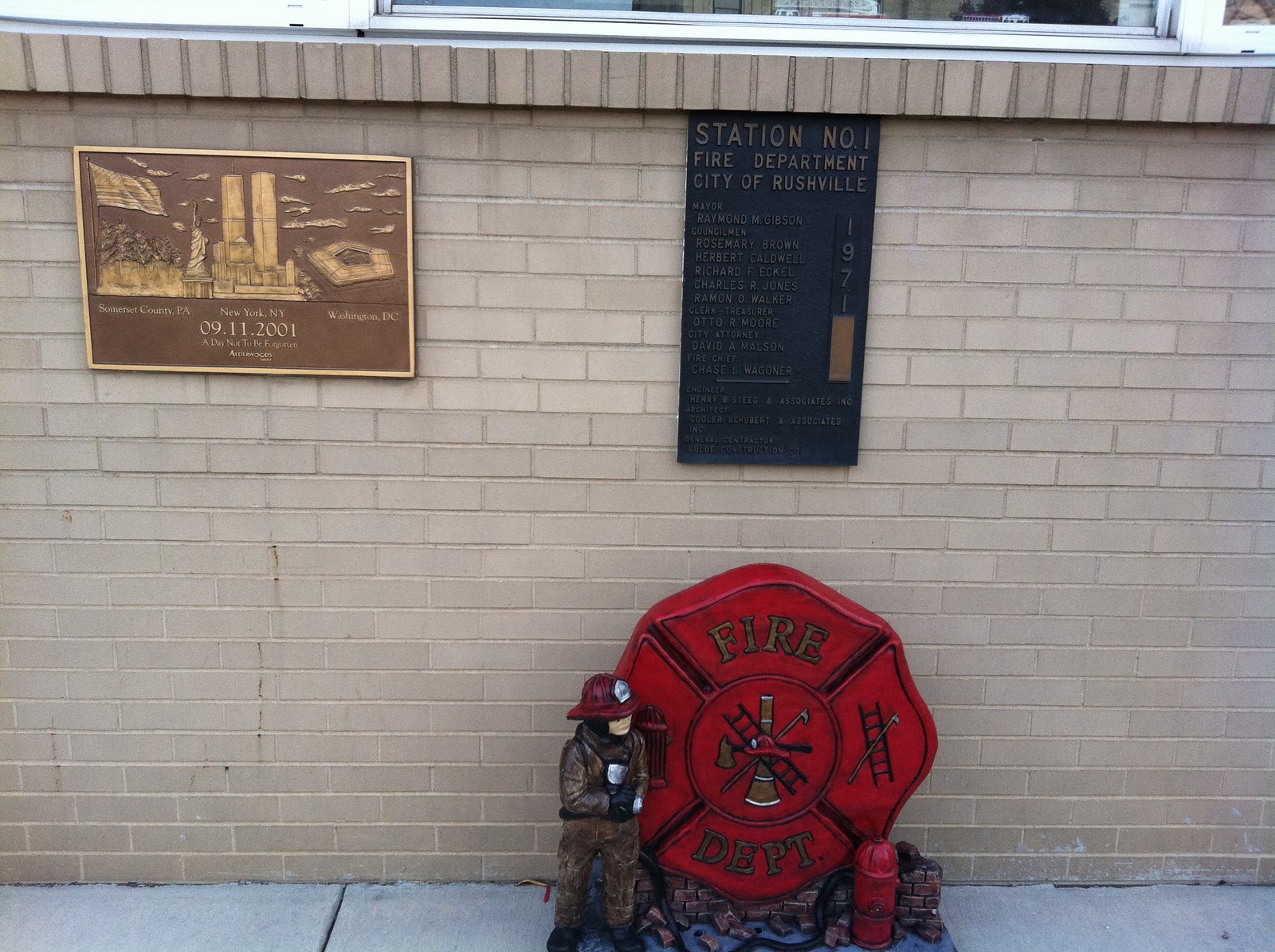
Rushville’s Fire Department gets a big bang with EECBG bucks!

We sent Megan down to Rushville a few months ago (okay, we're a little behind on the blog entries!) to check up on their EECBG project.  Here's her account of the visit.


The City of Rushville’s received one of our EECBG awards, using their $11,258 grant to fund lighting retrofits and upgrades at their fire department.  New occupancy sensors and 63 lighting fixtures were revamped to make the department’s facility more efficient. These new lights were installed in the sleeping berths, the truck bay, and TV area, among other locations in the facility.


 So far, they’ve saved 40,954 kWh and $1,204 in energy costs.

Thanks for the tour of the building! If I have another site visit to do in the future, I’m going to keep my fingers crossed that I get to ride in one of the trucks!

 
Rushville received an Energy Efficiency & Conservation Block Grant (EECBG) award.  EECBG is a program of the American Recovery & Reinvestment Act (ARRA) of 2009, funded through the U.S. Department of Energy and administered by the Indiana Office of Energy Development.

Thursday, December 8, 2011

Warrick County lights it up with EECBG


During her site visits in southern Indiana this past summer, Megan, one of our program managers, also visited Warrick County. Warrick County received $58,197 in EECBG funding for lighting retrofits in the Warrick County Courthouse and the Warrick County Security Center. Megan enjoyed her visit around the courthouse which is rich in history.  And now, you can see the history even better with improved lighting!


Not only is the new lighting pretty, it’s pretty efficient! Actually it’s really efficient! The county has seen a savings of over $8,000 from the improved lighting.

Thanks for your hospitality and hard work, Warrick County!


Warrick County received an Energy Efficiency & Conservation Block Grant (EECBG), which is funded through the American Recovery & Reinvestment Act (ARRA) of 2009 through the U.S. Department of Energy.  These funds are administered by the Indiana Office of Energy Development.

Wednesday, December 7, 2011

Ball State University's EECBG project

Not many people think about all of the equipment that goes into making a university computer system work, nor do they think about the amount of energy it takes to run and cool all of those servers.  In a time of rising costs, and increased competition, universities must do all that they can to keep their equipment up and running. 
With the help of a grant from the Indiana Office of Energy Development, Ball State was able to replace two existing 16 ton Liebert Computer Room Air Conditioners (CRACs) with three new in-row computer rack coolers in the Robert Bell building main computer room.  The new in-row rack coolers utilize central plant produced chilled water, the production of which is much more efficient than the existing CRACs.  This project will greatly reduce the buildings’ and the campus electrical demand in the immediate future and to an even greater extent once the campus is converted over to its new geothermal system.   The estimated savings will be over $34,000 per year.  As a bonus, the existing CRACs will remain available for backup use thereby also improving the reliability of all campus networks.

Ball State University received an Energy Efficiency & Conservation Block Grant (EECBG) in 2010.  EECBG is funded through the American Recovery & Reinvestment Act (ARRA) of 2009 through the U.S. Department of Energy.  The program is administered by the Indiana Office of Energy Development.

Tuesday, December 6, 2011

Horlander Enterprises: Lighting the Way


Horlander Enterprises (d/b/a NuYale) in Jeffersonville, Indiana is another benefactor of EECBG funding. The company is known for having an environmentally friendly dry-cleaning process so it was a natural fit for them to increase their conservation at the plant.
 

Horlander Enterprises received $21,642.53 for lighting retrofits in their plant. Funding was used to retrofit an existing 240 lights with more energy efficient fixtures and ballasts. They have seen $50,000 in savings from these improvements!

Congrats and keep up the good work on conservation and cleaning (dry-cleaning that is)!


The Energy Efficiency & Conservation Block Grant (EECBG) is funded by the American Recovery & Reinvestment Act (ARRA) of 2009 through the U.S. Department of Energy; it is administered by the Indiana Office of Energy Development.

Friday, November 4, 2011

Spotlight on Haynes International

Haynes International, headquartered in Kokomo, is a leading developer, manufacturer, and marketer of high performance nickel- and cobalt-based alloys used in corrosion and high-temperature applications.  After receiving CHIP funds from our office in 2010, Haynes International's staff will be able to see significantly better.  Their $400,000 grant (that cost at least $800,000 all said and done) retrofitted four buildings at their Kokomo plant.  These savings are estimated to save around $135,000 per year!

Energy conservation is nothing new to Haynes International, and these lighting retrofits are just part of their ongoing commitment.  During the past three years, Haynes implemented an ISO 14001 certified Environmental Management System (EMS) in 2007.  Through the EMS, Haynes has implemented programs to achieve reductions in electricity and natural gas usage.  These programs are continually tracked and the metrics are communicated within the organization.

Many thanks to the folks at Haynes International for allowing us to visit.  We look forward to the great things in store for you in the future.


Haynes International received CHIP funds through the Indiana Office of Energy Development.  These funds were made available through the U.S. Department of Energy's State Energy Program (SEP), funded through the American Recovery and Reinvestment Act (ARRA).

Wednesday, November 2, 2011

Ferdinand keeps it local

We sent Megan down south a few months ago and tasked her with writing about her journey.  Enjoy!

----------

There is not a good or easy way to get to the Town of Ferdinand from Indianapolis, so while the drive was certainly not my favorite, I did enjoy my site visit! Ferdinand received $20,430.00 in EECBG funding for a streetlight retrofit project. Thirty-seven (37) 100-watt incandescent streetlights along the town’s main street were retrofitted with 40 watt LED lights.

Not only did Ferdinand use lights that are manufactured nearby, they also used the Town’s maintenance workers to do the retrofits. It’s great that they were able to keep it local by providing work to their employees while also improving the town. They’ve reduced their energy consumption by 10,512.80 kWh and have seen an energy savings of $714.88.

To our friends down in Ferdinand, keep up the great work!

The Town of Ferdinand received a 2010 EECBG award from the Indiana Office of Energy Development (OED).  Funds are provided by the U.S. Department of Energy through the American Recovery & Reinvestment Act (ARRA).